Walk through any major train station in Japan and you will see them. Travelers with huge backpacks, staring at their phones, debating whether they need cash and where to get it. More and more, novice visitors are opting to forgo cash altogether. They limit their itinerary to places that accept cards or QR codes. They are, often without knowing it, harming local businesses in the process.
But how would they know? A preference for digital payments is pervasive. Domestic and international players, including Stripe, Square, Visa, and Alipay, as well as local competitors like PayPay, are happy to invite you to go cashless in Japan. The message is everywhere. Convenience. Speed. Points.
So why do so many independent and family owned businesses choose to accept only cash? The preference is deeper than you think. Asking to pay with a card has an incremental and damaging effect on the health of local businesses. It is not rudeness. It is survival.
The Fee That Eats
PayPay is the dominant QR code based digital payment platform in Japan. It is backed by Masayoshi Son’s SoftBank Group, SoftBank Vision Fund 2, and LY Corporation. It currently offers the lowest merchant transaction fee among major players: 1.98%. That sounds small.
But here is what history teaches us. With other venture capital backed platforms, once they become the dominant player, fees increase. We can expect PayPay’s fees to rise, possibly to the average rate of around 3% charged by Stripe, Square, and GMO Payment Gateway.
Three percent. That is the margin many small businesses survive on.
A local vegetable seller, a tofu shop, a traditional sweets maker, a fishmonger. Many of these businesses operate on margins of 3% or less. For them, accepting digital payment is not a cost of doing business. It is a net negative. They lose money on every transaction. They are paying for the privilege of serving you.
A Reluctance to Raise Prices
There is a deep hesitancy to raise prices among small businesses in Japan. Many have endured the boom and bust cycles of the Japanese economy. For them, the price is a promise. A contract with their customers.
Decades of deflation have made consumers price sensitive. While foreign visitors arrive with the surplus wealth of stronger currencies, Japanese salaries have remained largely unchanged since the early 1990s. The underlying cost of goods traded in dollars on the international market eats into the margins of businesses of all sizes. Small businesses absorb the loss. They do not pass it on.
The result is a slow, quiet suffocation. According to a February 2026 survey by Teikoku Databank, Japan’s average “price pass-through rate” was only 42.1%. For every ¥100 increase in costs, businesses could only recover ¥42.10 through price increases. The remaining ¥60 had to be absorbed by the business itself.
Consider the The Taxi Driver
Consider the kojin taxi driver. These are independent drivers who hold a special licence from the prefecture to operate their own car as a taxi. They earn that licence after years of service with a company taxi and a legal examination. You can identify them by the round medallion on their roof. 個人タクシー.
In a recent report by the Asahi Shimbun, some independent taxi drivers in Fukuoka are choosing to avoid ride-hailing apps. They say both drivers and passengers feel manipulated by the convenience that the apps promise. One driver, Kawauchi Shinsuke, works about ten hours a day. He says if he makes ¥30,000 in sales, “that is good enough.”
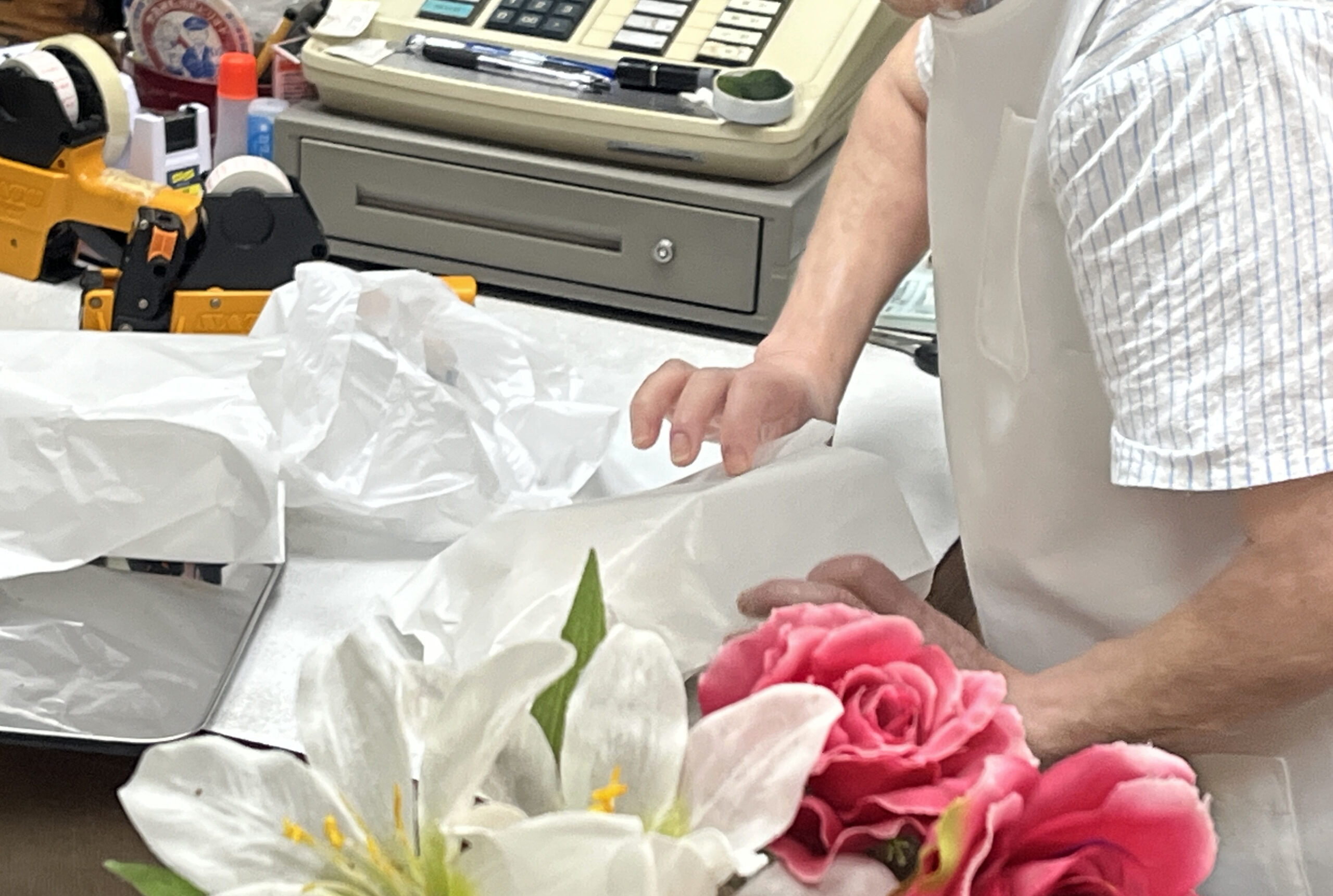
He does not use ride-hailing apps. He waits at station rotaries and cruises nightlife districts. He manages his own payments as a one-person business operation. When you choose to pay with a credit card, you are subtracting roughly 3% of his total fare. Not from a faceless corporation. From him.
And consider this. Japan does not have a tipping culture. You enjoy the courtesy of that absence. By showing a preference for credit cards, you are effectively picking that driver’s pocket. On top of your personal privilege.
The Bigger Picture
Macroeconomic forces are crushing small businesses. Costs are skyrocketing. The weak yen, rising energy, raw material, logistics, and labor costs have all surged. The Corporate Goods Price Index has risen far faster than the Consumer Price Index, meaning businesses could not pass on the cost increases to consumers. They absorbed them.
This is not a matter of bad management. This is a structural squeeze. And digital payment fees are a tax on that squeeze.
How to Get Cash
Carrying cash has a number of benefits. You are paying to keep small businesses alive, rather than watching them be eaten up, gentrified, and erased. Look at what has happened to Shinsekai area in Naniwa-ku. That is the alternative.
You can withdraw cash from any ATM with your debit card linked to a Visa or Mastercard checking account in your home country. Do this. And be proud to pay in cash, knowing that you are being courteous to the business owner. You are not being backward. You are showing consideration and reciprocity for the kindness shown to you while in Japan.
Inside a century‑old former residence in Arima Onsen, kissaten Chikutaku serves medicinal keema curry under the glow of vintage pinball machines.
By Kometani, Kuma
Arima Onsen, Hyogo Prefecture.Jimejime na, an old man said to his wife on the morning Hankyu train to Takarazuka Terminal, dabbing sweat from his brow with a komon handkerchief. Humid and heavy, the kind of morning that makes you want to sit still and not move.
Today the author is traveling a well worn route, over the mountains on the Arima Kaido to the nestled hot spring town of the same name. The bus from Takarazuka Station departs at a normal pitch but climbs quickly into the mountains, switchbacks stacking one after another as the driver murmurs into his microphone in slushy, lethargic, indecipherable banshuben. The bus groans, but the mountain doesn’t care.
This road was meant for an electric railway that never came; before that, it was the Arima Kaido, a multiday journey for emperors and samurai who came to heal their bodies.
The Train That Never Was
For centuries the Arima Kaido connected Osaka and Kobe to Arima Onsen, a path traveled by emperors, aristocrats, and Toyotomi Hideyoshi himself. Post towns like Kohama-juku flourished as resting stops, known even for their sake brewing.
But the most interesting part of this road’s history is the one that never happened, because the bus you ride exists only because a railway does not. In the early 20th century, the Minoh Arima Electric Railway sought to extend their existing network from Takarazuka over the mountain to Arima Onsen, the plan being to cross the mountain along the Arima Kaido corridor and descend into the valley. Engineers decided the steep, rugged terrain was too difficult, so the dream later died in 1913.
They built a bus route instead. The Takarazuka Arima Jidōsha service was commemorated to cover the last mile over the mountain, and today, as your bus climbs Akasaka Pass, you are following ancient footsteps on a road that was almost a railway.
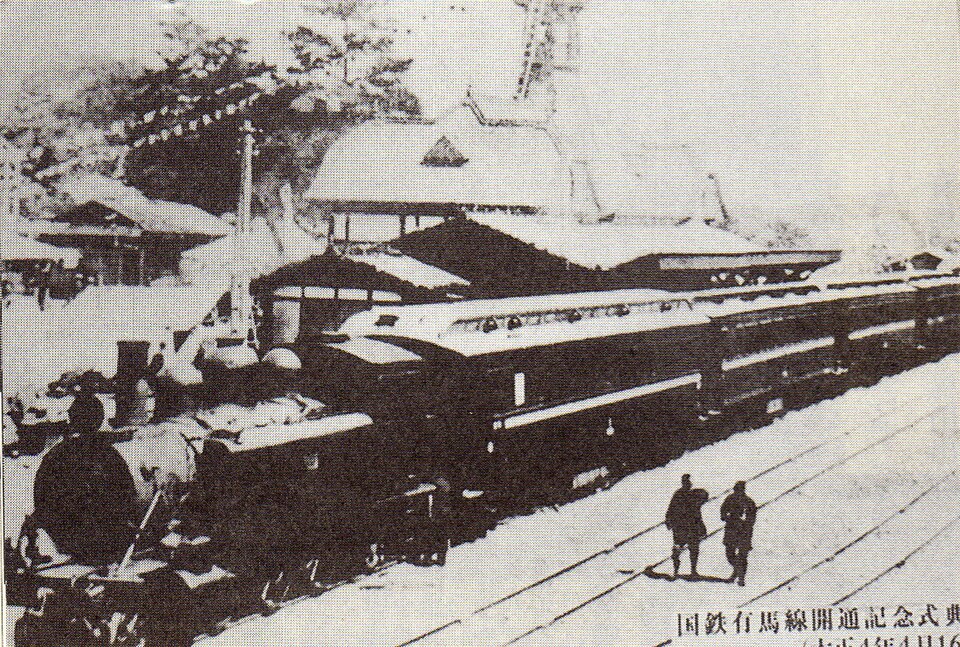
The opening ceremony of the JNR Arima Line at Arima Station, 1928. While this photograph depicts a different railway (the JNR line, which was eventually built), it offers a rare visual echo of the era when the Minoh Arima Electric Railway’s planned connection over the mountain was abandoned. The station and the surrounding landscape remain much as they would have appeared when the “ghost railway” was first dreamed of and then died. This image is in the public domain (copyright expired; published in Japan before 1929).
The Basin
Arima Onsen spreads out from the mountain stream that anchors the main bus terminal, the road winding in three directions and tucking inns, souvenir shops, and restaurants into the folds of the valley. At the basin a concrete drainage channel creates a cool recessed space with benches and shade, where locals and tourists dip their feet in the cold mountain water.
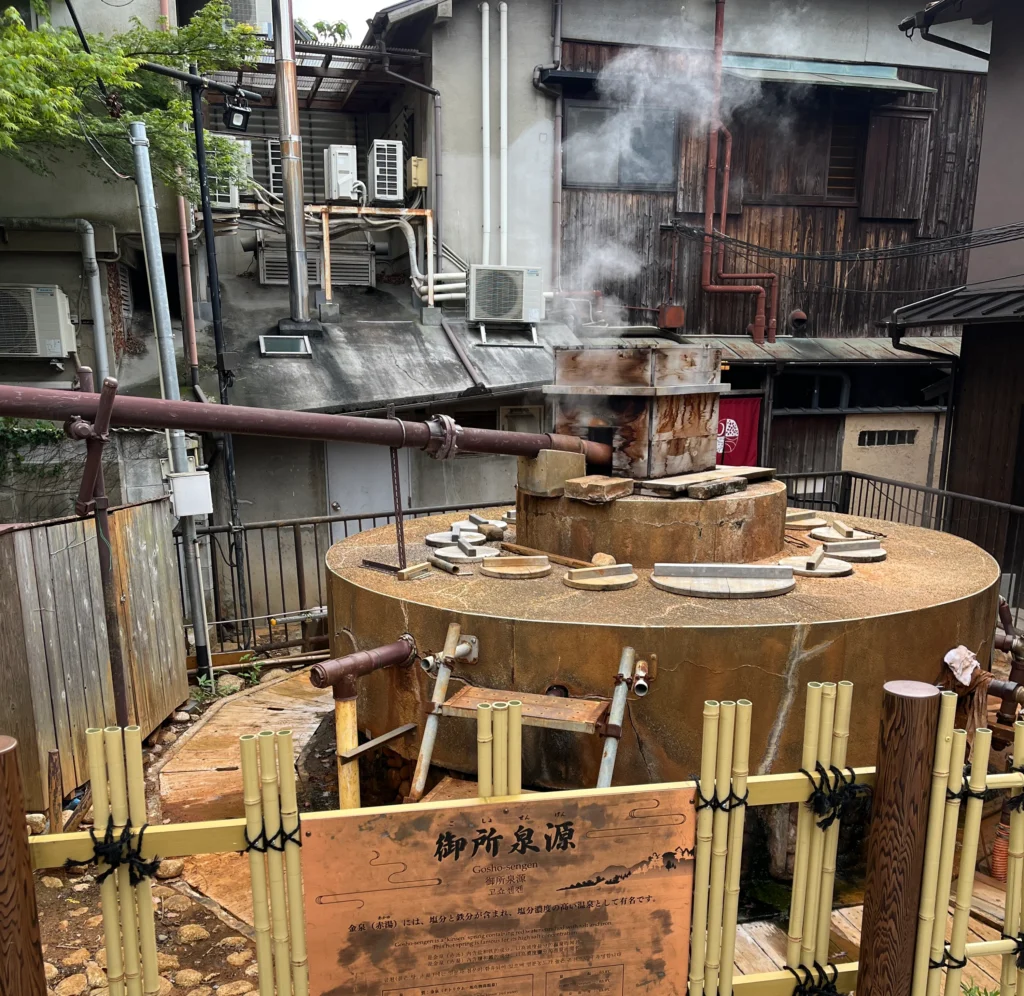
You walk past inns, omiyageya, and restaurants, heading toward the source. The water here is famous: Kin no Yu, the golden spring, is rich in iron and salt, leaving a russet stain on white towels and said to heal everything from fatigue to chronic pain. Hideyoshi himself came here to soak, holding tea parties on the riverbank while his retainers sweated in the steam.
It is strange to think that what was once reserved for emperors is now open to anyone: a salaryman, a student, a gourmand with too much free time. We soak in the same water, and the logistics of our modern world unfold in my imagination as a quiet miracle. I think about this while sitting in the crimson water, crowded with other visitors (it is the fastest onsen day trip from Osaka and Kobe), and my leg loosens as the pain fades.
Feeling better, I stroll further up in search of a late lunch or snack, though it is nearly 3pm and many of the best lunch restaurants close at this hour to prepare for dinner. Then I see a small signboard, hand painted, the kind that folds out from a hinge on the top, with an arrow and one word: “Omurice.”
Well, I think, that’s a clue. I pause long enough to feel my hunger, then follow the arrow.
The Clock and the Pinball
Turning the corner past a gift shop, I enter. “Mou mata aiteiru no?” I ask, gingerly. The woman at the counter has beautiful hands and a straight posture, and she leads me to the dining area, partitioned by a bookshelf. The restaurant is fairly empty, so I take a table in a sunroom open to the cooling breeze and sloping village streets.
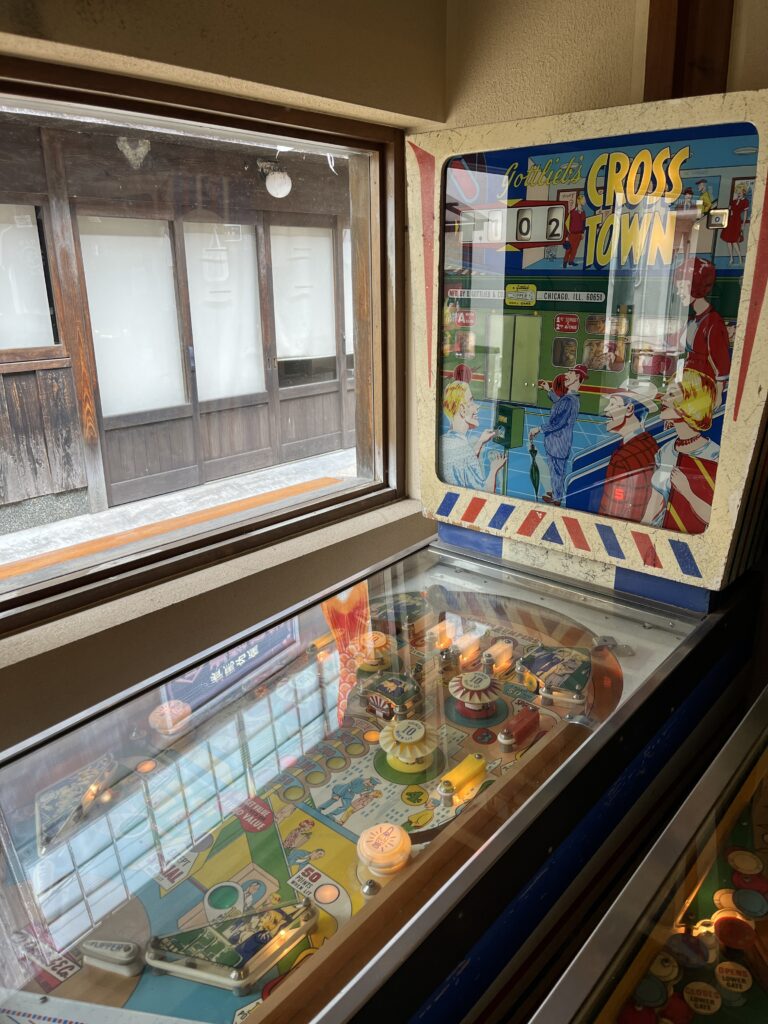
I look around the room, then at the menu, and there in the corner, unmistakably, are three vintage pinball machines. The interior has the atmosphere of an old storehouse; in the hundred year old building, the wooden beams glow in the late afternoon sun. TchicTac (Tick Tock) is filled with hardwood furniture, clocks, and electromechanical ephemera, the whole place steeped in Taisho Roman, that brief era of romantic nostalgia.
The most prominent pinball machine is called “Cross Town,” from 1966, of which only 2,765 units were produced. It still works. One hundred yen for a game. Two other machines of similar vintage sit beside it, quiet and waiting.
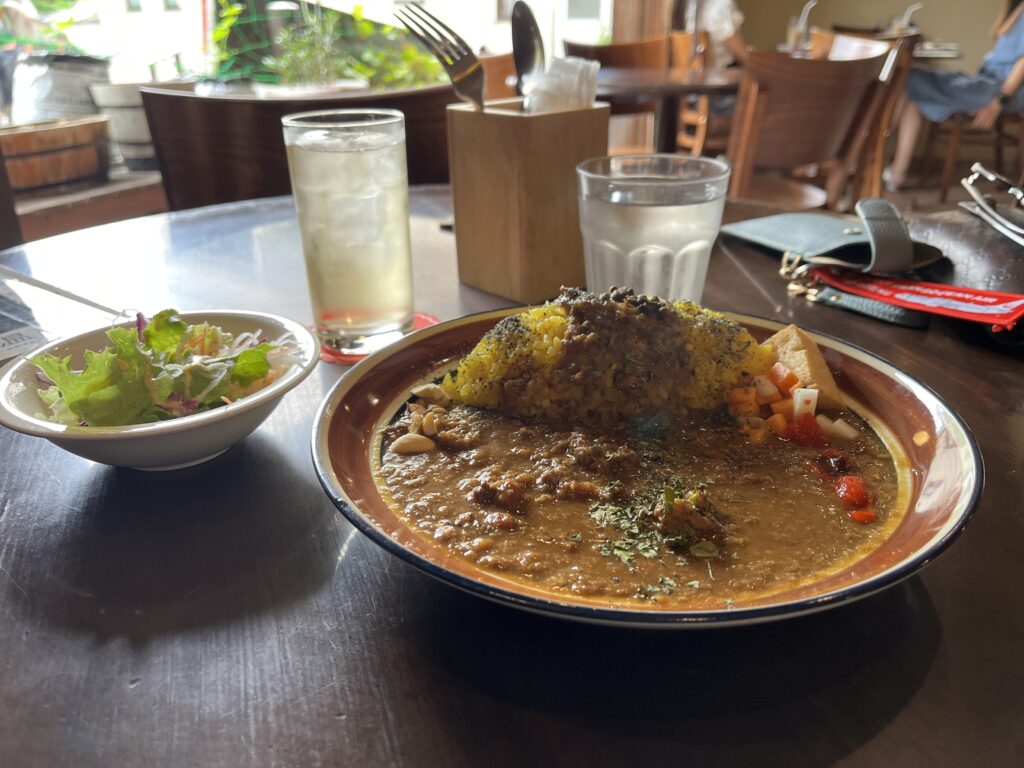
I reconsider the omurice. It is the obvious choice, the menu describing fluffy natural eggs with a demi‑glace sauce simmered for an entire day, wrapped around ketchup rice. It sounds good, but it also sounds heavy. So I order the keema curry instead, listed as “Arima Medicinal Keema Curry” with a small asterisk noting the use of local sansho pepper. They call it medicinal; I call it lunch. I add a whisky soda, because a cold drink on a hot afternoon is never wrong.
As the glass beads with condensation, I watch the street scene outside. Between the sunroom and the engawa, a rope trellis holds young passion fruit vines just beginning to climb. Then the food arrives.
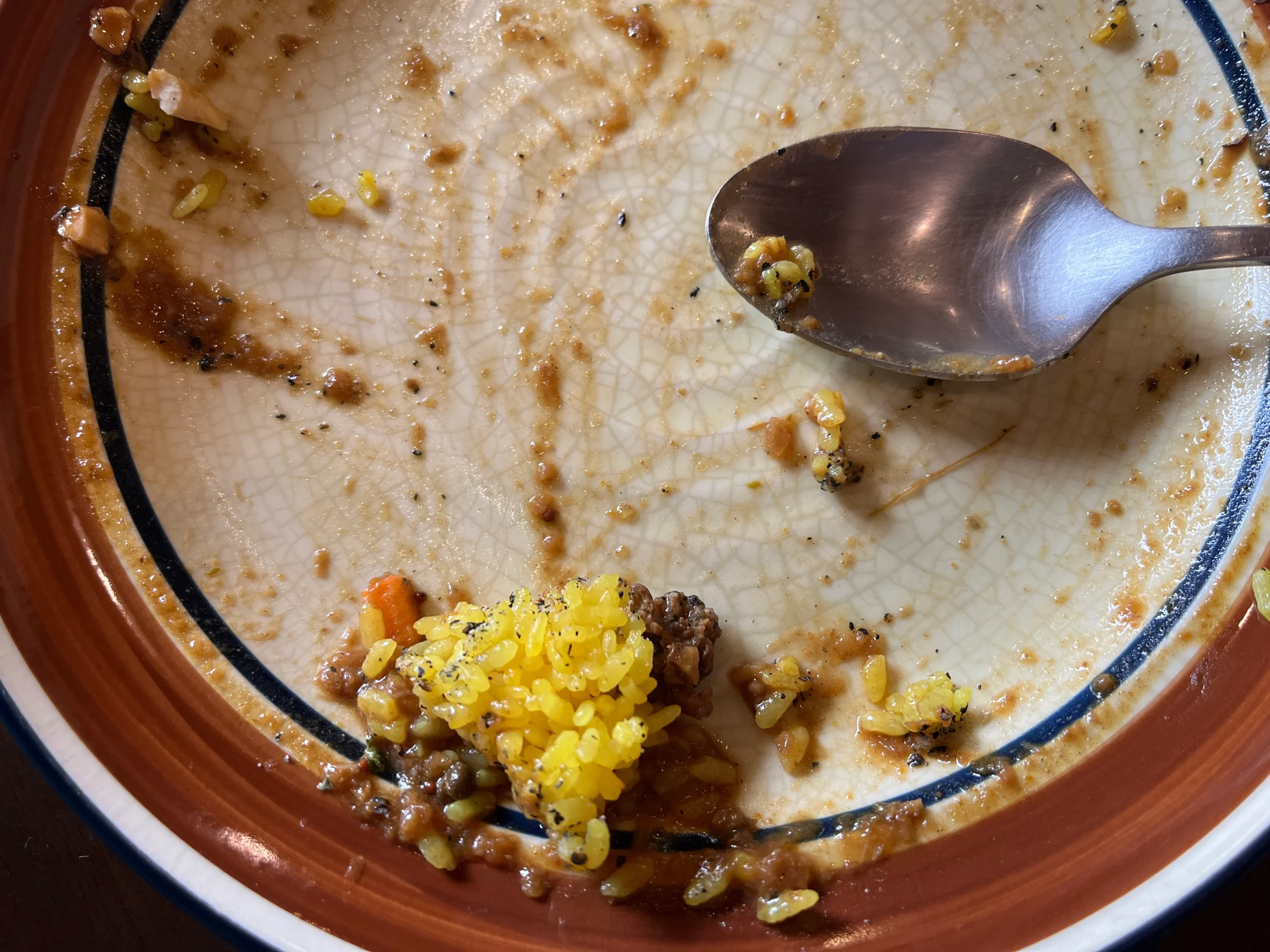
The plate is a beautiful crackled ceramic Kannyu plate, its glaze fractured like old ice. The curry occupies the center, a modest but confident mound of finely minced meat and vegetables, dark amber with hints of crimson from tomato and perhaps a touch of paprika. It is not a wet curry; the consistency is that of a loose paste, clinging to itself without pooling.
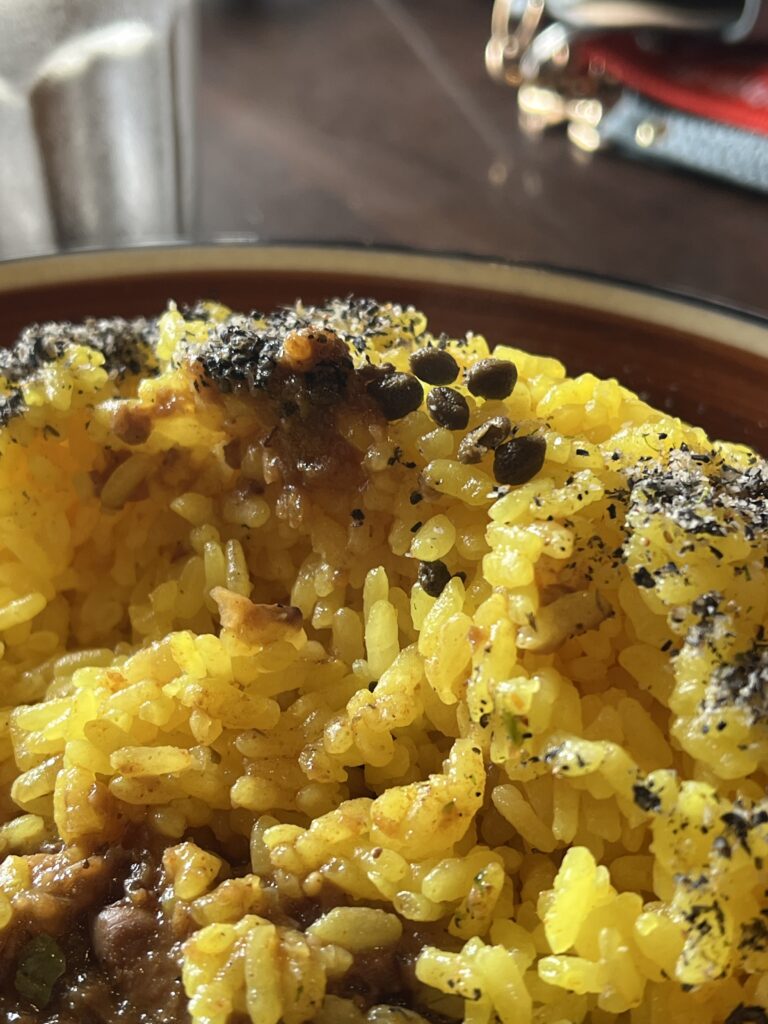
The nose is greeted first by the warm, earthy fragrance of cumin and coriander, then by a sharper, almost citrusy note that can only be Arima sansho. Unlike Sichuan peppercorn, which numbs, sansho delivers a clean, fleeting tingle, like a tiny electrical spark followed by the scent of young leaves. There is also a low, smoky bass note that seems to come from nowhere in the visible ingredients.
A single cube of atsuage is plated tastefully to the side of the curry, not buried inside. I save it for last. When I finally break through its soft, spongy crust, the inside reveals the source of that smoke: the atsuage has been lightly smoked over wood, giving it a campfire depth that balances the bright, sharp spices of the curry. It makes for an interesting last bite.
Alongside the curry sits a small, fresh salad of tsuma (thinly shredded daikon) and mixed greens, dressed only with a whisper of rice vinegar. Its purpose is textural and thermal: cool, crisp, neutral. On the edge of the plate, fast‑pickled carrots and red bell pepper add a note of crunch and tang to every bite they touch. They are sweet‑sour, with a decisive crunch, and they reset the palate between bites of the heavier curry.
The effect of the Arima sansho builds slowly. After three or four bites, a gentle vibration spreads across the tongue and lips, not painful, just insistent. It heightens every other flavor: the sweetness of the carrots, the smoke of the atsuage, the harmony of flavors in the curry base. The menu calls it “medicinal,” and I understand why. The pepper is said to aid digestion and warm the body from within. In the humid, heavy air of the onsen town, it feels precisely right.
The whisky soda is simply whisky and soda water over ice. Its bubbles and clean finish serve as a palate cleanser between different bites, allowing me to enjoy the plate slowly. The restaurant also serves coffee, beer, and local Arima cider, including the carbonated spring water known as “Teppo Mizu.”
I eat slowly, deliberately, taking small portions of seasoned long grain rice and alternating with the pickles and salad. Passersby notice the plate and the aroma of rice and spice, glancing longingly into the restaurant. The kitchen staff exchange looks.
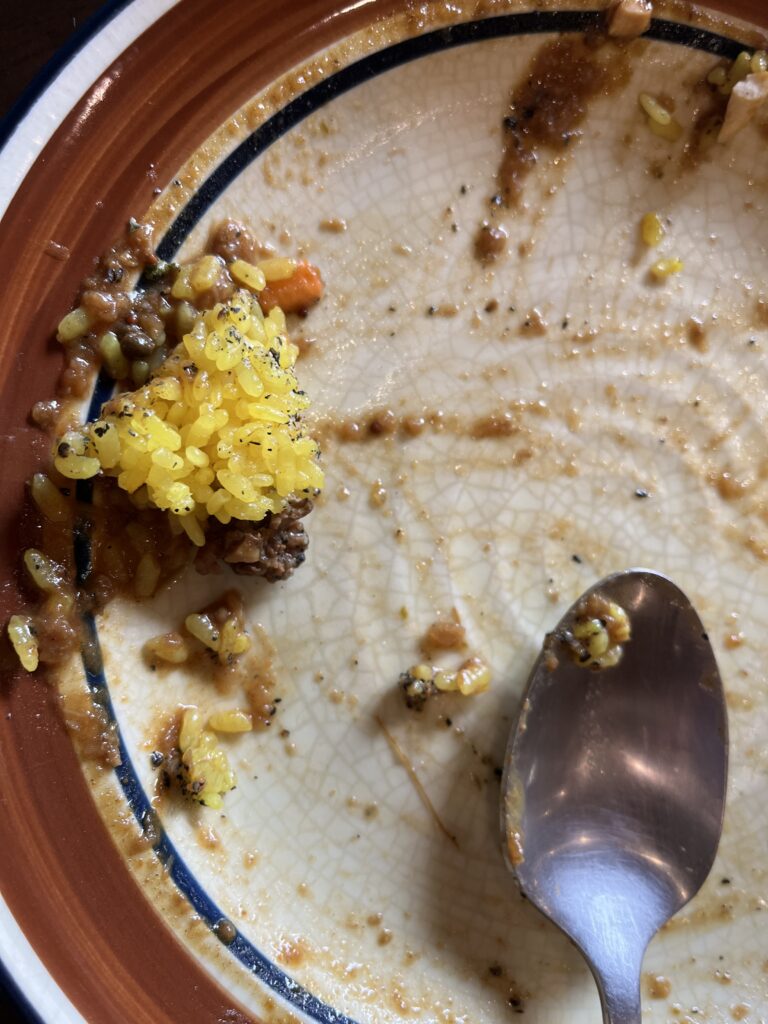
By the time I finish the curry, the highball is gone, and the afternoon light has shifted from gold to amber. My leg, still sore from the morning, feels almost forgotten. The sansho warmth lingers on my lips like a promise.
Last Ball
I finish the highball and the curry, then pay at the counter. As I do, I compliment the passion fruit vines on the trellis. “They are goya,” the woman says, “an Okinawan vegetable. Bitter, but delicious when cooked with a little oil.”
With that, I thank them and start to leave. Just then a group of six people push through the door and ask if they are still open. Outside, the mountain stream continues to run, the wooden buildings glow gold in the late afternoon light, and somewhere up the hill, a train that never was still waits for no one.
Chikutaku (茶房 チックタク) https://tchictac.jp/ 820 Arima cho, Kita ku, Kobe shi, Hyogo 651 1401 Open daily 11:00 to 16:00. Last order 15:00. Closed Tuesdays. Cards and cash accepted. Seven minute walk from Arima Onsen Station.
Shonai, Toyonaka, Osaka — Summer days stretch long in the northern suburbs, and the heat comes off the asphalt in visible waves. On a Saturday, I found myself taking a meandering route home from an early morning sauna, a long, contemplative soak in a hinoki tub at Yume no Kōshitsu Yokujō Goshiki, a sprawling traditional bathhouse that sits at the improbable intersection of the Hanshin Expressway and a vacuum-sealant manufacturer.
The bathhouse itself is a time capsule: vintage 1970s tilework, recently renovated with a bubbling fountain and koi swimming under glass floor panels. It has become justifiably popular for its rich, inexpensive, and voluminous curry udon. But I skipped the udon. I wanted to walk.
I wove in and out of back streets, letting my nose lead. And then I caught it: the smell of sweet sauce and grilled chicken. But this was not the round, sugary aroma of yakitori tare laced with sake. This was different, sharper, almost ketchup-like, with a tart tang. The unmistakable scent of okonomiyaki sauce hitting a hot iron. But chicken? At this hour?
I turned the corner.
The Blue Noren: First Clues of a True Osaka Diner
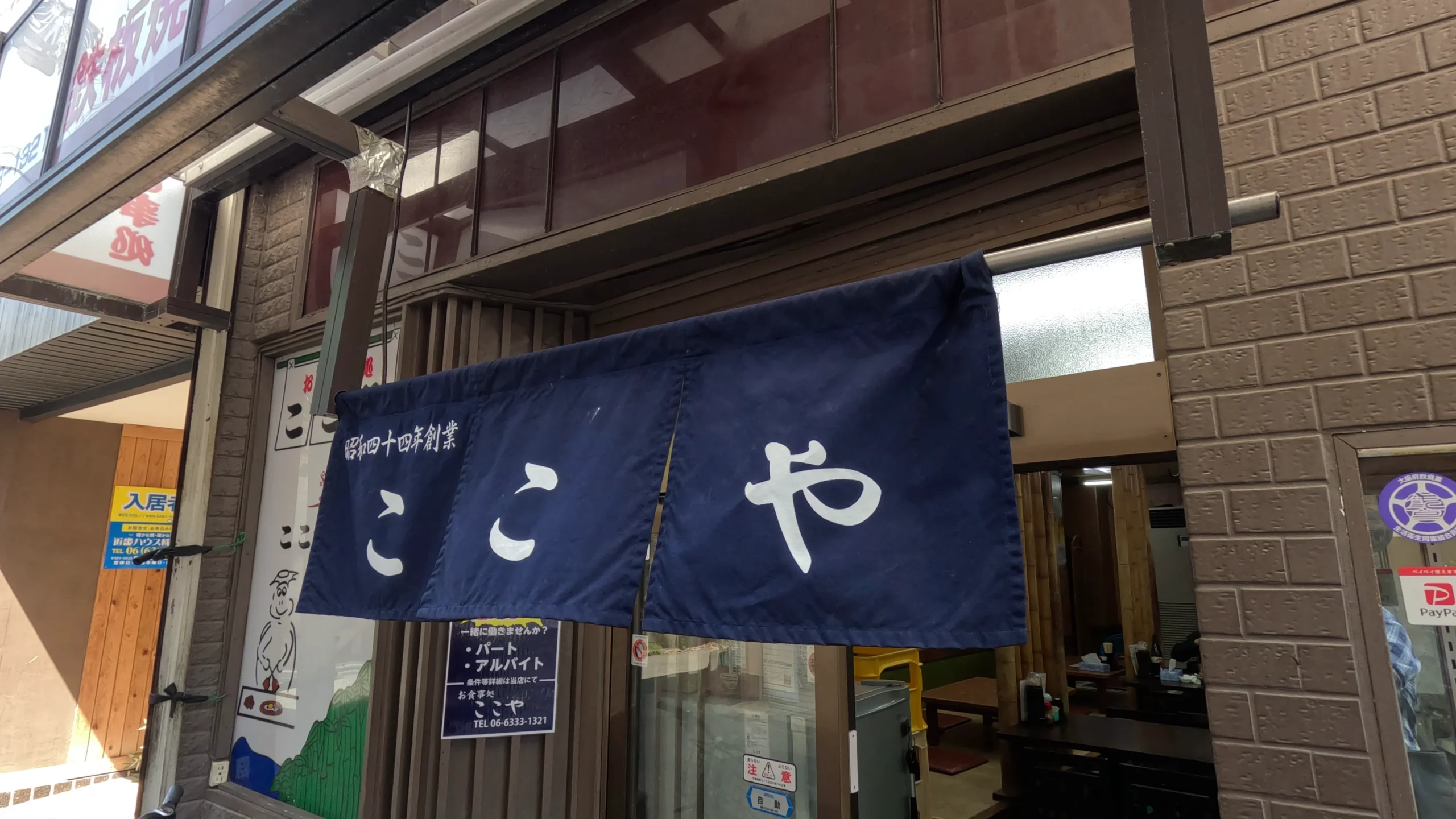
A short line had formed in front of a blue noren curtain. A few men and women in basketball shorts and t-shirts hung out by the door, smoking Seven Stars and continuing their conversation with the commotion inside. It was still morning.
Ah, I thought. This is something worth investigating.
The purpose of life, as I have come to believe it, is the discovery of flavor, passion, aroma, and the rendering of ingredients. And this shokudo had all the hallmarks of a hidden gem:
An early morning crowd.
Extremely casual banter.
A line of people who look like they just got out of bed.
Yes. I had found something special.
Entering the Stage
I circled back twice, surveying both entries. The line had dissipated, which gave me an opening. I pulled the sliding door gently to the left. Full house. In polite Japanese, I asked the elder woman, who seemed to be having lively conversations with every table, “Ima, seki ga aite imasen ka?” (Is there a seat open now?)
The man behind the large, U-shaped teppanyaki grill was a brick house of a human. He looked left, then right, and gave a small frown. Ahhhh, I thought. Maybe no good.
But food takes time. And if my instincts were correct, I had already made an important discovery.
I waited outside for four minutes. Then a pair of happy-looking regulars poked their heads out through the noren on their way out. I was greeted with a big smile, the kind you don’t fake, and asked them what the most popular dish was, noting the wonderful smell.
They recommended the tonpeiyaki, a humble pork chop grilled hot on the flattop, wrapped in a thin egg pancake with mayonnaise, sauces, and scallions. (For the record, my top tonpeiyaki in Osaka still goes to Dontaku in Doyama-chō for its spicy Chinese mustard punch. But I would learn to hold that opinion lightly.)
The regulars said something to the family inside, something that translated roughly to “that weird large man outside is still here,” and invited me in. A seat had opened at the counter, just to the right of the chef.
The Anxiety of the Newcomer
For a small moment, trepidation gripped the staff. They were trying to understand how best to serve me. Is this person literate? It’s a valid question. One awkward customer can spoil the atmosphere of a packed house, and I respect that. Choosing the correct customers, especially in a small, family-run space, is like choosing ingredients. The selection matters.
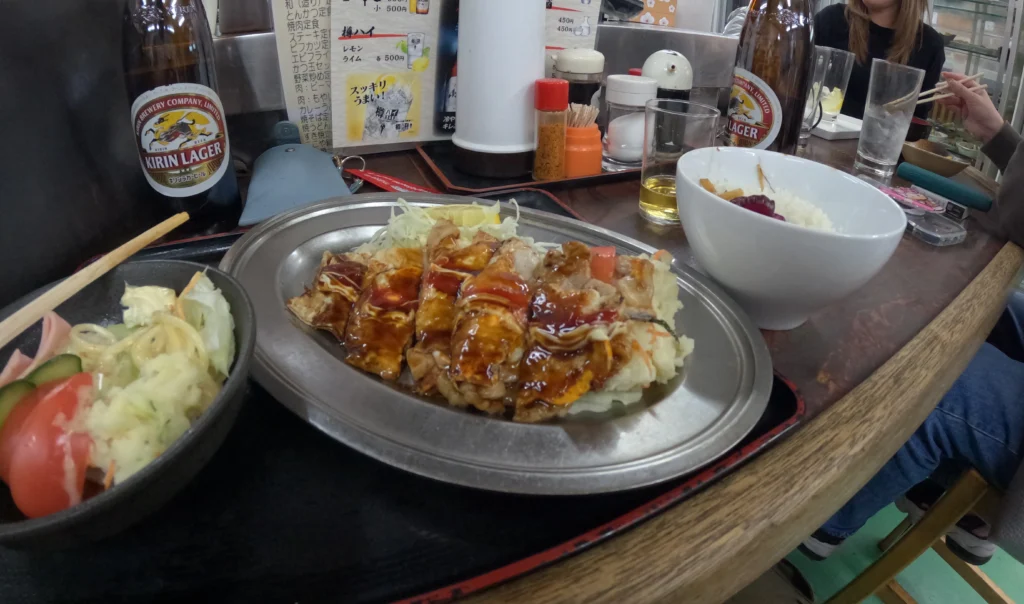
I ordered a Kirin bottle, a peace offering, and quickly scanned the paper menu. I ordered the first dish that sounded delicious in that instant. This instinct is important to cultivate: one should decide within the space of a single breath upon seeing a menu item. Spontaneous inspiration is a muscle.
I ordered yakiudon.
It is a simple enough dish, impossible to mess up, and would buy me time to watch the chef’s process. More importantly, it would allow me to watch dishes come out of the kitchen. This slight of hand is crucial: order something you can slowly enjoy while studying the kitchen for seasonal ingredients and off-menu treasures.
The Diner
Sitting there, it struck me: this is a diner atmosphere. Like a British café. Like a Northeastern greasy spoon. It is also, unmistakably, a family-run business.
The matron, a woman of unknowable age but with beautiful smile lines carved from decades of banter, worked the room, talking with every table. The cook, a man of about fifty, stood behind the hot iron while staff passed ingredients from the kitchen to the front. The teppan is the stage around which the entire restaurant is organized. Orders are shouted to the cook, then relayed back. Stainless bowls of prepped ingredients come forward in a steady, practiced rhythm.
On the western wall, above a drinks cooler, hung straw sandals from Hattori Tenjin shrine, the local shrine whose history dates to 901 AD, founded on a legend of miraculous healing of the feet. (The author himself once had his foot crushed in an industrial accident and prayed there before having his bones fused back together. But that is another story.)
On the grill, the master was grilling and steaming whole chopped chicken drumsticks and thighs. Whole halves of a bird, throwing seasonings left and right, jetting sauce and liquid, allowing everything to steam and then crisp. The smell was heaven.
From my perch, I could see into the fridge under the counter. Bright, no, incandescent strips of lean wagyu were prepped and waiting. The humble environment belied a secret: care taken towards the selection of ingredients.
The Yakiudon
My yakiudon arrived in about fifteen minutes, which left me genuinely hungry. Another wonderful build of anticipation.
As the dish hit my nostrils, I noticed something immediately: the sauce, often just called “sauce” in Osaka regional restaurants, was more acidic than expected. I am an absolute fiend for suppai (sour) flavors. And this house-made sauce had a strong note of citric acid. Lemon juice. Possibly orange juice. Underneath: sugar, sake, salt, and shoyu. While surely impossible to know, perhaps Otafuku as a base, enhanced with an additional bite, like Worcestershire and lemon. A deep and complicated blend of tart, sweet, spice, and umami.
“Momo, Kore de Owari”
Sometime around noon, on my second beer, the cook mentioned to the kitchen that this was the last chicken. He would not be cooking any more today.
“Momo, kore de owari.”
A testament to their ingredient freshness: they cook the day’s offerings until sold out. No more. No less.
I nursed my beer. Having finished my udon, I gathered the courage to order a second entrée. Do not disrespect the advice, I thought, and ordered the tonpeiyaki.
It was very good. A lean cut of pork, cooked until slightly browned and glazed with the same sauce as my udon. Drizzled with scallions, wrapped in a thin egg batter, served with a gentle thin drizzling of mayonnaise. The pork had a clean, honest flavor, no excess fat, just the sweetness of the grill the tang of the sauce, and the roundness of the egg.
The Treasure Fridge
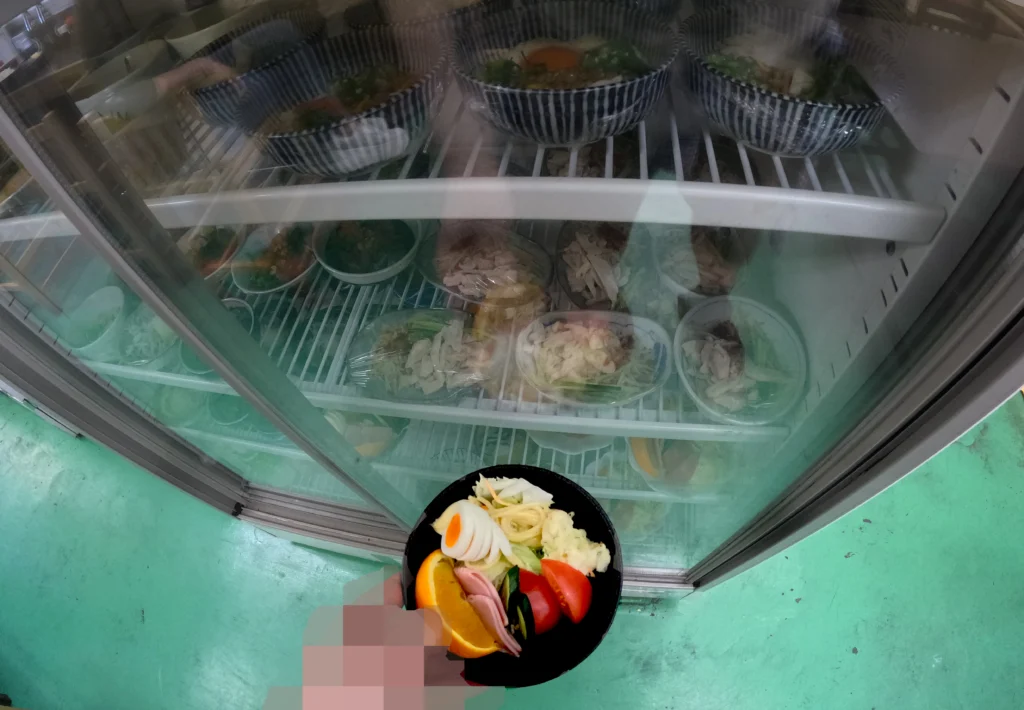
A curious feature of this cafeteria: two sliding glass coolers filled with small plates wrapped in plastic wrap. This kind of self-service can only come from a family kitchen, I thought. Pasta salad. Greens. Potato salad. Fruits. Snacks. You can pull anything from the fridge, so long as you announce your choice to the house staff.
“Salad, ichi sara!” I called out, as I lumbered back to the counter on my shitty foot.
From the kitchen, I saw shrimp and many other delicacies fly out over the counter. Ebi. Katsu. Sukiyaki. Drinks flowed out, feeding a lively atmosphere that never felt rushed, only full.
Last Call
As the morning rush died down, I finished my tonpeiyaki, miso soup, fresh pickles, and rice. I thanked the staff. The matron smiled. The brick-house cook gave a small nod. A part timer came in late with messy hair and apologized for several minuntes for oversleeping though the morning rush- everyone smiled and joked with them. iiyo! The blue noren fluttered as I stepped back into the heat.
Outside, the line had started to form again.
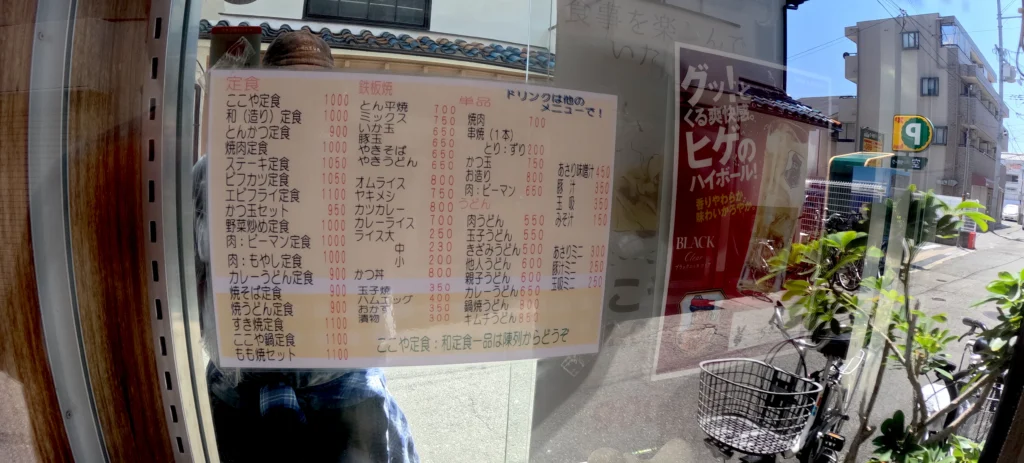
Menu (May, 2026)
定食 (Teishoku / Set Meals)
ここや定食 (Kokoya Teishoku / Kokoya Set Meal) — ¥1,000
和(造り)定食 (Wa (Tsukuri) Teishoku / Japanese Sashimi Set Meal) — ¥1,000
とんかつ定食 (Tonkatsu Teishoku / Pork Cutlet Set Meal) — ¥900
焼肉定食 (Yakiniku Teishoku / Grilled Meat Set Meal) — ¥1,000
ステーキ定食 (Sutēki Teishoku / Steak Set Meal) — ¥1,050
ビフカツ定食 (Bifukatsu Teishoku / Beef Cutlet Set Meal) — ¥1,050
エビフライ定食 (Ebifurai Teishoku / Fried Shrimp Set Meal) — ¥1,100
ドリンクは他のメニューで! (Dorinku wa hoka no menyū de! / For drinks, please see the other menu!)
ここや定食:和定食一品は陳列からどうぞ (Kokoya Teishoku: Wa-teishoku ippin wa chinretsu kara dōzo / For the Kokoya Set Meal & Japanese Set Meal, please choose one side dish from the display case.)
Kokoya (ここや)
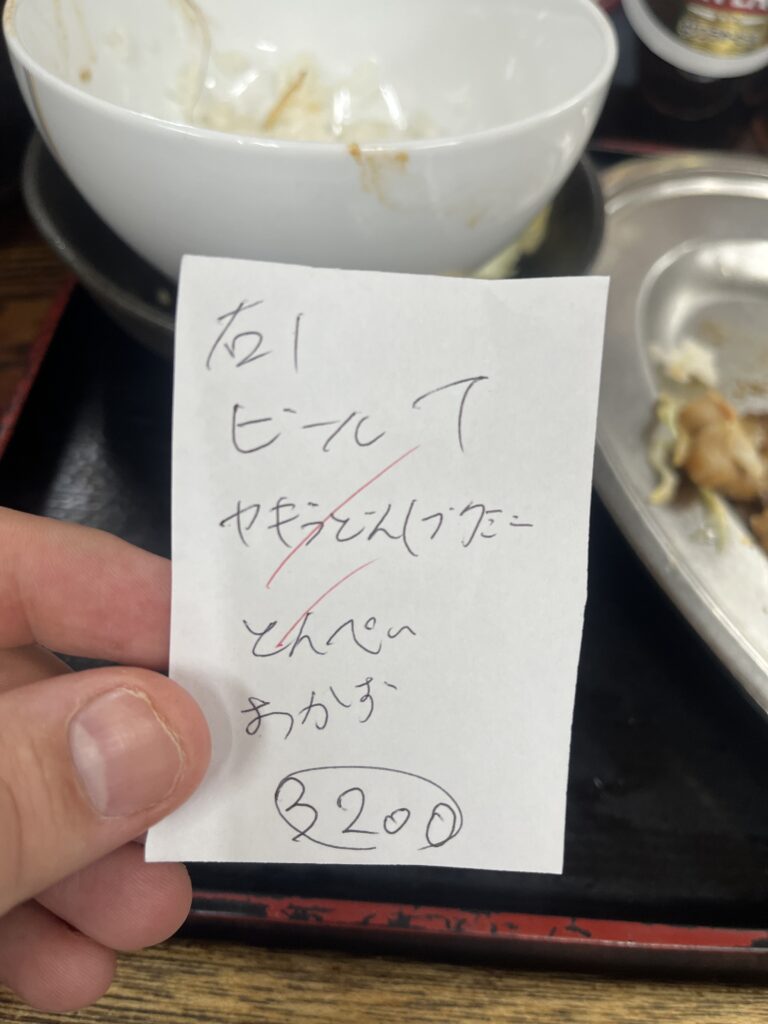
3 Chome-5-10 Shonai Nishimachi, Toyonaka, Osaka 561-0832 Closed Thursdays. Open 11 AM–8 PM all other days. Cash only. No English menu. Point at what your neighbor is eating.
Access: 5 minutes walk from Shonai Station on the Hankyu Takarazuka Line
Welcome to Kansai Epicurean, a definitive gastronomic journal dedicated to the nuanced culinary landscapes of Osaka, Kyoto, Kobe, and Nara.
Kansai Epicurean was born from a desire to elevate culinary appreciation and bypass traditional fast-consumption travel content. On this site, you’ll find long-form, deeply researched investigations into kitchens, menus, and the architectural spaces they inhabit. We prioritize the story first—biographies of chefs and the chemistry of flavors—supported by rich multimedia.
Based in North Osaka, the editor is a bilingual, decade-long resident deeply embedded in the region’s culinary culture.
The Vision Our goal is to elevate the discussion of food in the Kinki region, and highlight the hard work of chefs, cooks, and the supply chain that supports them. We move beyond trend following, superficial observation to offer a comprehensive investigation of Kansai’s best kitchens. We don’t just find food; we find the heartbeat of the Nation’s Kitchen.